Xbox Console Generations: Original Xbox to Series X|S
From the original Xbox in 2001 to Series X|S: launch dates, mid-generation refreshes and the features each generation introduced, from Xbox Live onward.
Microsoft entered the console business in 2001 as an outsider, a software company building a box to compete with Sony and Nintendo. A quarter of a century later, the Xbox family spans four generations and a long list of features that the whole industry now takes for granted, from integrated online accounts to Achievements. This guide walks through each generation in order, covering launch dates, hardware revisions and the strategy shifts that shaped what you play on an Xbox today.
The Original Xbox (2001): A PC Company Builds a Console
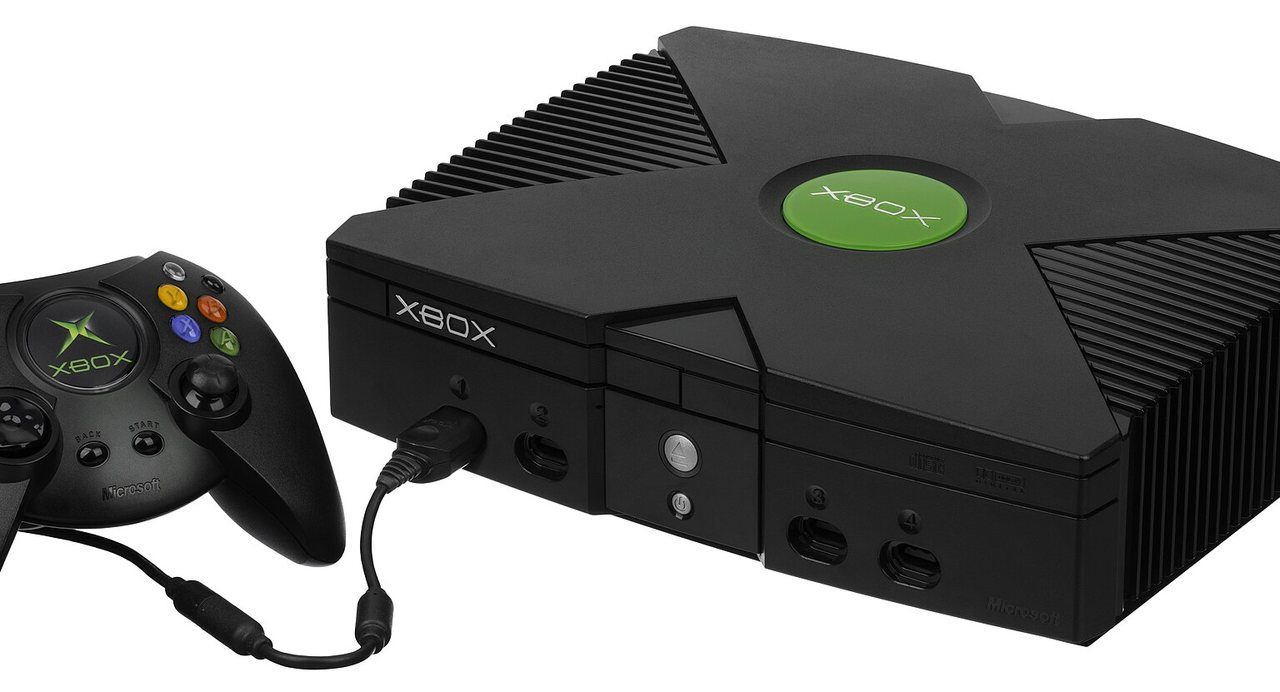
The first Xbox launched in North America on November 15, 2001, followed by Japan on February 22, 2002, and Europe and Australia on March 14, 2002. Microsoft built it with PC-style components: an Intel processor, an Nvidia graphics chip and, unusually for the time, a built-in hard drive. That hard drive meant games could save large amounts of data, and players could rip music CDs to use as custom soundtracks in supported games.
Key innovation: Xbox Live
The original console also had a built-in Ethernet port, and Microsoft used it to launch Xbox Live in November 2002. Unlike earlier console online efforts, where each publisher ran its own systems, Xbox Live gave players a single identity (the gamertag), a unified friends list and voice chat with a headset across games. It was a paid service that ran on broadband only, a bold bet in an era when many homes still used dial-up.
Legacy
The first Xbox is remembered for its oversized “Duke” controller (later replaced by the smaller Controller S), and for establishing that Microsoft could build a credible platform. It also introduced a launch franchise that defined Xbox for years, and it laid the groundwork for every online feature that followed.
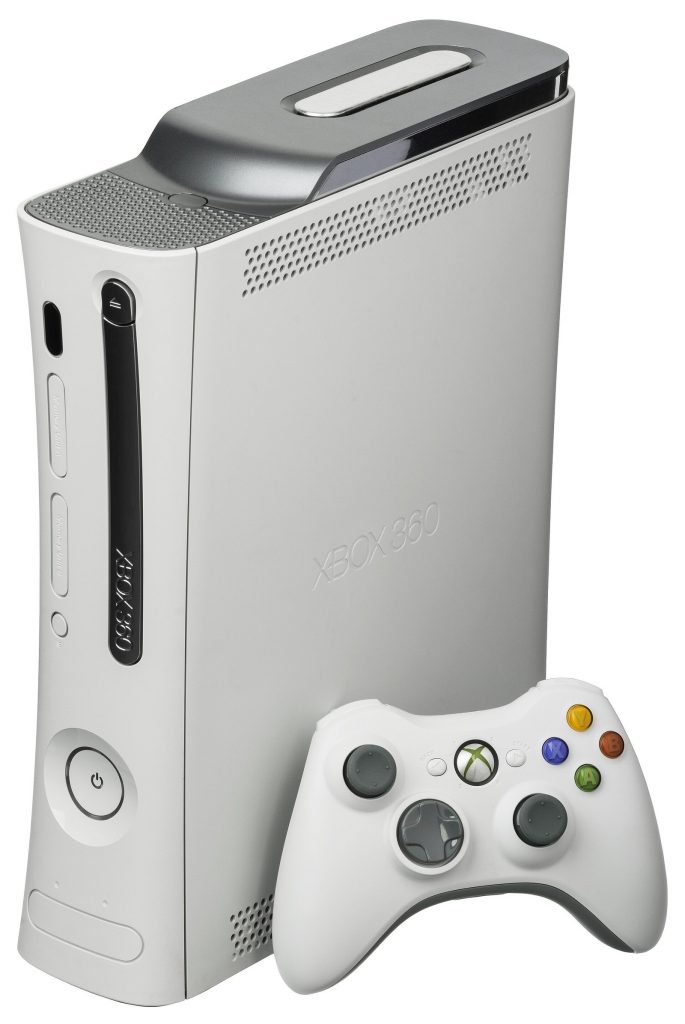
Xbox 360 (2005): Achievements and the Connected Console
The Xbox 360 launched in North America on November 22, 2005, then in Europe on December 2 and Japan on December 10, 2005. Arriving a year before its main competitor gave it a long head start in that generation.
Key innovation: Achievements and Gamerscore
Every Xbox 360 game shipped with Achievements, goals set by the developer that awarded points toward a player’s Gamerscore. This simple system-level feature gave players a reason to revisit games and a public record of what they had done, and it was quickly copied across the industry.
Key innovation: the dashboard and Xbox Live Arcade
The 360 placed Xbox Live at the center of the console, with a system-wide friends list, messaging and invites available from any game via the Guide button. Xbox Live Arcade turned the console into a storefront for smaller downloadable games, helping launch many independent studios onto consoles.
Key innovation: Kinect
Kinect, a camera and depth sensor for controller-free play, launched in North America on November 4, 2010. It sold strongly at first and pushed Xbox toward family and fitness audiences, though support faded over time.
Revisions
The original 360 was followed by the slimmer Xbox 360 S in 2010, which added built-in Wi-Fi and a dedicated Kinect port, and the Xbox 360 E in 2013. The early generation is also remembered for hardware reliability problems, which Microsoft addressed with an extended warranty program.
Xbox One (2013): An All-in-One Entertainment Box
The Xbox One launched on November 22, 2013. Microsoft initially pitched it as a hub for TV, apps and games, with Kinect bundled in the box and HDMI pass-through for a cable or satellite box.
A strategy reversal before launch
Microsoft’s original plan included regular online check-ins and restrictions on used games. After strong criticism following its reveal, the company reversed those policies in June 2013, before the console launched. A year later, Microsoft also began selling the console without Kinect, and the sensor’s role diminished steadily; Kinect manufacturing ended in 2017.
Key innovation: backward compatibility as a service
The Xbox One was not designed to play older games, but Microsoft added Xbox 360 backward compatibility through software in November 2015, followed by selected original Xbox games in 2017. Compatible games could be played from disc or from a digital library, and some received enhancements. This program became one of the platform’s defining features.
Key innovation: Game Pass
Xbox Game Pass launched on June 1, 2017, offering a rotating library of games for a monthly subscription. It later grew to include Microsoft’s own games on their release day, reshaping how the company thought about selling games.
Revisions: One S and One X
- Xbox One S (August 2, 2016): smaller, with 4K Ultra HD Blu-ray playback, HDR support for games and 4K video streaming.
- Xbox One X (November 7, 2017): a more powerful mid-generation model aimed at native 4K gaming, with games receiving “Xbox One X Enhanced” patches.
- Xbox One S All-Digital Edition (May 7, 2019): the first disc-less Xbox, aimed at digital and Game Pass players.
Xbox Series X|S (2020): Two Consoles, One Generation
The current generation launched on November 10, 2020 with two consoles at once: the powerful Xbox Series X, aimed at 4K, and the compact, all-digital Xbox Series S, aimed at 1440p. Our comparison of the Series X and Series S explains the hardware differences in detail.
Key innovations
- Xbox Velocity Architecture: a custom NVMe SSD paired with hardware decompression, dramatically reducing load times.
- Quick Resume: several games can be suspended at once and resumed in seconds, even after the console has been in Sleep.
- Smart Delivery: buy a supported game once and the console automatically installs the best version for that hardware, whether Xbox One or Series X|S.
- Backward compatibility at launch: thousands of Xbox One games plus the curated Xbox 360 and original Xbox library, with system-level improvements such as Auto HDR and FPS Boost in selected titles.
- Storage Expansion Cards: proprietary cards that match the internal SSD’s speed.
Later models
Microsoft added a 1TB Series S in 2023 and, in 2024, a disc-less Series X Digital Edition and a 2TB Galaxy Black Series X, alongside a 1TB white Series S.
How the Xbox Strategy Has Shifted
Hardware tells only part of the story. Across the generations, Microsoft’s priorities have changed noticeably:
- Online first (2001–2005). Xbox Live set Microsoft apart, and online multiplayer became its signature.
- Mass-market expansion (2010–2013). Kinect and media apps pushed toward families and living-room entertainment.
- Back to games and the player’s library (2014–2019). After a difficult Xbox One launch, Microsoft emphasized backward compatibility, Game Pass and the idea that purchases would follow players to new hardware.
- Studios and subscriptions (2018 onward). Microsoft acquired many studios, including ZeniMax Media in 2021 and Activision Blizzard in 2023, feeding Game Pass with first-party releases.
- Beyond one console (2024 onward). Microsoft began releasing several of its first-party games on other platforms, including PlayStation 5, and promoting play on PC and other screens through the Xbox app.
Alongside these shifts, the subscription brands changed too. Xbox Live was renamed Xbox network in 2021, and the old Xbox Live Gold membership was folded into Game Pass in 2023, so online multiplayer on console is now part of a Game Pass tier.
Generations at a Glance
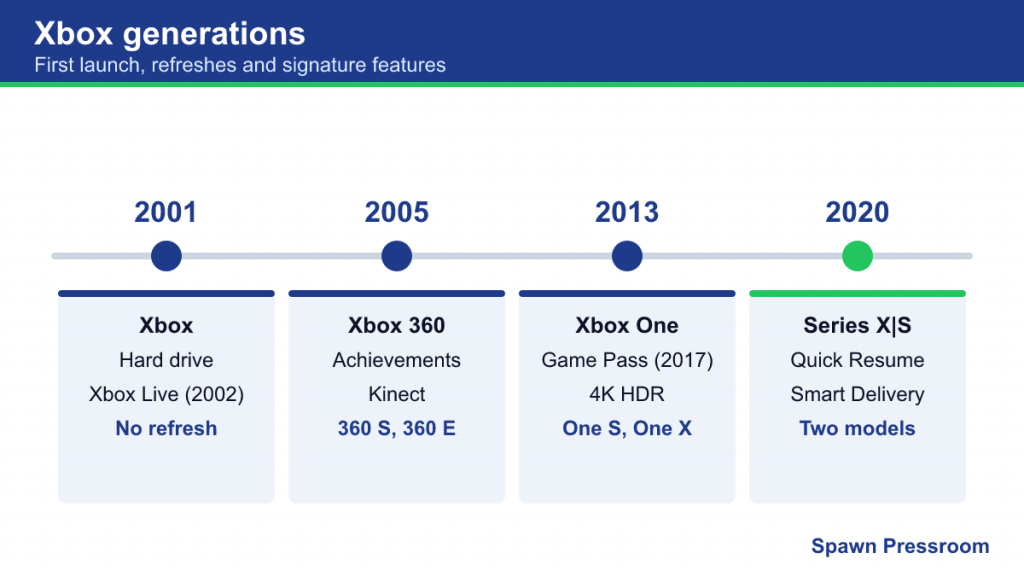
| Generation | First launch | Refreshes | Signature features |
|---|---|---|---|
| Xbox | Nov 15, 2001 | None (controller revised) | Built-in hard drive and Ethernet; Xbox Live (2002) |
| Xbox 360 | Nov 22, 2005 | 360 S (2010), 360 E (2013) | Achievements, Gamerscore, Xbox Live Arcade, Kinect |
| Xbox One | Nov 22, 2013 | One S (2016), One X (2017), One S All-Digital (2019) | Backward compatibility program, Game Pass (2017), 4K HDR |
| Xbox Series X|S | Nov 10, 2020 | Series S 1TB, Series X Digital, Series X 2TB | Velocity Architecture, Quick Resume, Smart Delivery |
Features That Carried Over
One reason Xbox players tend to stay with the platform across generations is continuity. A gamertag created in 2002 still works today. Achievements earned on Xbox 360 remain on the profile alongside current ones. Many digital Xbox 360 purchases are playable on Series X|S, and Smart Delivery means many Xbox One purchases upgrade for free. The controller has also changed gradually: the Xbox One pad refined the 360 design, and the Series X|S controller added a Share button and a hybrid D-pad while staying compatible with Xbox One consoles.
Common Questions
Which Xbox had the first disc-less model?
The Xbox One S All-Digital Edition in 2019. The Series S continued the idea, and a digital Series X followed in 2024.
Can a Series X|S play every older Xbox game?
No. It plays nearly all Xbox One games but only a curated list of Xbox 360 and original Xbox titles. Microsoft stopped adding new older-generation titles to the program in 2021.
What happened to Xbox Live Gold?
For most of Xbox history, online multiplayer required a paid Xbox Live Gold membership, which also delivered free monthly games under the Games with Gold program from 2013. In September 2023 Microsoft replaced Gold with an entry-level Game Pass tier, and existing Gold memberships converted automatically. The tier names have changed again since then, so check Xbox.com for the current lineup before subscribing.
Is an Xbox One still worth keeping?
An Xbox One still runs its own library, its backward compatible Xbox 360 and original Xbox games, and most media apps. However, many newer releases are built only for Series X|S, so an Xbox One increasingly works best as a second console or a way to play an existing collection rather than a machine for the latest games.
Has Microsoft announced the next Xbox?
Microsoft has said it is working on future hardware, but as of October 2026 no next-generation console has been officially named, specified or dated.