PS5 vs Xbox Series X: An Evergreen Feature Comparison
PS5 and Xbox Series X compared on hardware, controllers, storage, subscriptions, backward compatibility, exclusives and interface, without a forced winner.
The PlayStation 5 and Xbox Series X launched within days of each other in November 2020, and they are closer in raw capability than any rival consoles before them. Both use AMD Zen 2 processors and RDNA 2 graphics, both have fast custom SSDs, both target 4K at up to 120 frames per second. The real differences sit elsewhere: in the controller in your hands, the way storage expands, the subscriptions, how far back each console reaches into older libraries, and how each company now treats exclusive games. This comparison walks through those areas one at a time so you can decide which set of trade-offs fits you.
Hardware Philosophy
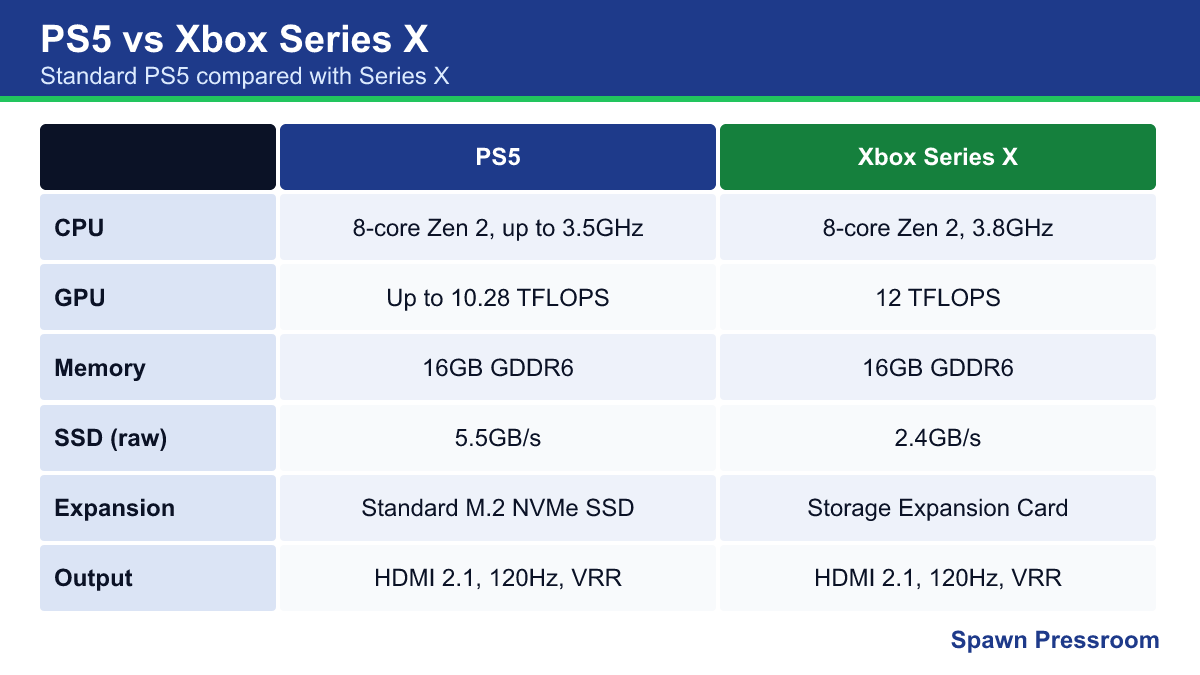
On paper the Xbox Series X has the bigger graphics processor: 12 TFLOPS from 52 compute units at a fixed 1.825GHz. The standard PS5 GPU delivers up to 10.28 TFLOPS from 36 compute units at a variable clock of up to 2.23GHz. Sony’s design lets the CPU and GPU clocks shift within a fixed power budget, while Microsoft runs fixed clocks.
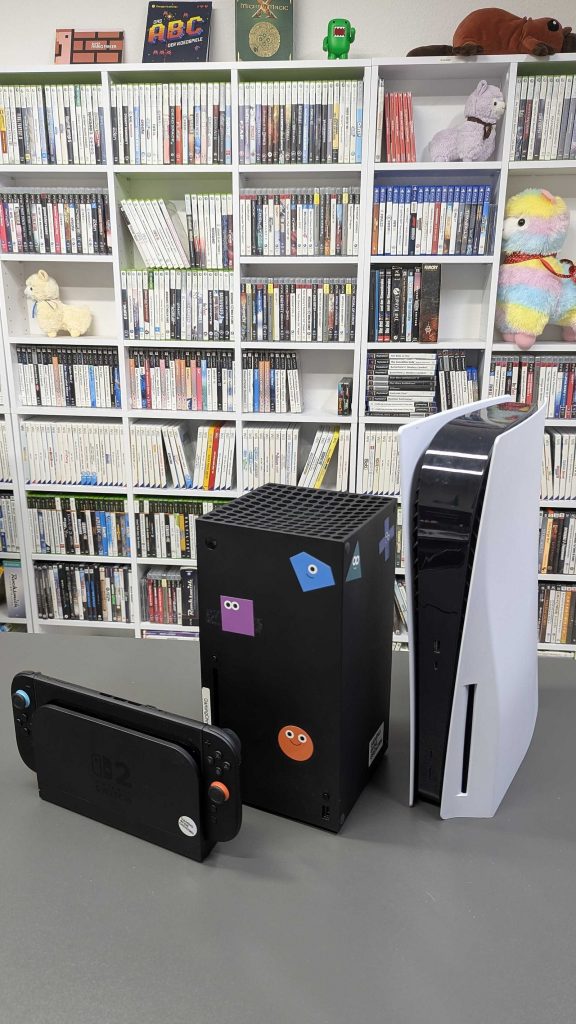
Sony’s emphasis went into the storage and I/O system. The PS5’s 825GB custom SSD was announced at 5.5GB/s raw throughput, while the Series X SSD is rated at 2.4GB/s raw. Both consoles add hardware decompression to push effective speeds higher, and in practice both load modern games dramatically faster than the previous generation.
What does this mean when you play? In multiplatform games the two consoles usually look and run very similarly. Some games favor one console slightly, others favor the other, and patches often change the picture. For most players the difference is far smaller than the difference between, say, a performance mode and a quality mode in the same game.
The PS5 Pro factor
Sony also sells the PS5 Pro (launched November 2024), a more powerful model with a larger GPU and PSSR upscaling. Microsoft has no direct equivalent in the Series X|S generation. If you are comparing top-end PlayStation hardware with top-end Xbox hardware, the Pro is part of the picture. See our guide to every PS5 model for how the Pro differs from the standard console.
Specifications Compared
| Feature | PS5 (standard) | Xbox Series X |
|---|---|---|
| CPU | 8-core Zen 2, up to 3.5GHz (variable) | 8-core Zen 2, 3.8GHz (3.6GHz with SMT) |
| GPU | Up to 10.28 TFLOPS, 36 CUs | 12 TFLOPS, 52 CUs |
| Memory | 16GB GDDR6, 448GB/s | 16GB GDDR6 (10GB at 560GB/s, 6GB at 336GB/s) |
| Internal storage | 825GB (launch), 1TB (Slim), 825GB (2025 Digital revision) | 1TB or 2TB |
| SSD raw throughput | 5.5GB/s | 2.4GB/s |
| Storage expansion | Standard M.2 NVMe SSD (PCIe Gen4) + USB | Proprietary Storage Expansion Card + USB |
| Disc drive | Ultra HD Blu-ray (built in or detachable, depending on model) | 4K UHD Blu-ray (disc models) |
| Output | HDMI 2.1, up to 120Hz, VRR | HDMI 2.1, up to 120Hz, VRR |
Both consoles also offer all-digital versions, so a disc drive is a choice rather than a given on either side.
Controllers
This is one of the most noticeable everyday differences, and it is largely a matter of taste.
PS5 DualSense
- Haptic feedback with fine-grained vibration that can simulate textures and impacts.
- Adaptive triggers whose resistance changes in supported games.
- Built-in microphone and speaker, touchpad, and a Create button for captures.
- Symmetrical analog stick layout and a built-in rechargeable battery charged over USB-C.
Xbox Wireless Controller
- Offset (asymmetrical) analog sticks and a hybrid D-pad.
- Impulse triggers with rumble motors in the triggers themselves.
- A dedicated Share button.
- Runs on AA batteries by default, with optional rechargeable packs; this lets you swap batteries instantly instead of plugging in.
- Works with Xbox One consoles too, and Xbox One controllers work on Series X|S.
Both companies sell premium “pro” controllers with back paddles and adjustable sticks: the DualSense Edge and the Xbox Elite Series 2. Xbox also offers the Xbox Adaptive Controller, and PlayStation offers the Access controller, both designed for players with disabilities.
Storage Expansion
Both consoles fill up quickly with modern games, and the two companies chose very different upgrade paths.
- PS5 has an internal M.2 slot that accepts standard PCIe Gen4 NVMe SSDs meeting Sony’s size and speed requirements, with a heatsink recommended. Because these are standard drives, you can choose from many brands and capacities. Installation involves removing a cover, which takes a few minutes and a screwdriver.
- Xbox Series X|S uses Storage Expansion Cards, proprietary cartridges that slot into the back of the console with no tools. They perform exactly like the internal drive, but only a few manufacturers produce them.
Both consoles can also store games on external USB drives. On both, current-generation games must be moved to fast internal or expansion storage to play, while last-generation games (PS4 on PlayStation; Xbox One, Xbox 360 and original Xbox on Xbox) can run straight from USB.
Subscriptions
Each platform’s subscription is tiered, and each includes online multiplayer at its lowest level. Catalogs rotate and features vary by region, so treat this as an overview of structure rather than a list of games.
| PlayStation Plus | Xbox Game Pass | |
|---|---|---|
| Tiers | Essential, Extra, Premium | Essential, Premium, Ultimate (plus a separate PC Game Pass) |
| Online multiplayer | All tiers | All console tiers |
| Rotating game library | Extra and Premium (Game Catalog) | All tiers, growing in size with each tier |
| Monthly games to claim | All tiers | Not part of the current model |
| New first-party games on release day | Not a standard benefit | Ultimate (select games; Call of Duty excluded since 2026) |
| Older-generation classics | Premium (Classics Catalog) | Backward compatible titles in the library where included |
| Cloud save storage | All tiers (100GB) | Cloud saves are free for all players |
The big philosophical difference is day-one releases: Game Pass Ultimate brings many of Microsoft’s own new games into the subscription at launch, while Sony generally sells its new first-party games separately and adds some to the Game Catalog later.
Backward Compatibility
Xbox has the broader reach. A Series X plays almost all Xbox One games plus a curated list of Xbox 360 and original Xbox titles, from disc or digitally, with system-level extras such as Auto HDR and, in selected games, FPS Boost. Microsoft added its final batch of older-generation titles in November 2021.
The PS5 plays the vast majority of PS4 games, from disc or download, many with Game Boost improving performance. It does not play PS3, PS2 or PS1 discs; a selection of those older games is available through the PlayStation Plus Premium Classics Catalog or as separate digital purchases.
If you have a large shelf of Xbox 360 discs, that tilts things toward Xbox. If you are moving from a PS4 with a big digital library, the PS5 carries that library forward smoothly.
Exclusives Strategy
This area has changed more than any other since launch, so dates matter.
- Sony releases its major first-party games on PS5 first. Many later arrive on PC, typically after a gap, but they do not come to Xbox.
- Microsoft, starting in 2024, began releasing several of its first-party games on PlayStation 5 as well, sometimes at launch and sometimes later. For Xbox owners, the main draw is no longer strict exclusivity but having those games included in Game Pass and playable across Xbox consoles and PC.
Because policies continue to evolve, it is worth checking a specific game’s platforms before choosing a console for it.
Interface and Ecosystem
The PS5 home screen separates Games and Media, and its Control Center offers Activity cards that can jump straight into a level or challenge in supported games. Trophies, Game Base for friends and parties, and a built-in Game Help feature for PS Plus members round it out.
The Xbox dashboard is built around customizable groups and pins, the Guide button menu and Quick Resume, which keeps several games suspended so you can switch between them in seconds. Achievements and Gamerscore carry over from Xbox 360 days, and the Xbox app on phones and PCs ties into the same account.
Both systems support remote installs from a phone app, family controls through companion apps, and remote play to other devices.
Misconceptions Worth Clearing Up
- “More teraflops always means better-looking games.” TFLOPS measure one kind of GPU throughput. Memory bandwidth, developer tools, upscaling and how much time a studio spends on each version all affect the final result, which is why multiplatform comparisons often end up close.
- “A faster SSD means everything loads twice as fast.” Load times depend on how a game is built. Many multiplatform games load in similar times on both consoles because they are not designed around the maximum speed of either drive.
- “Xbox has no disc-free option at the top end” or “PS5 always comes with a drive.” Both are outdated: there is a digital Series X, and newer PS5 and PS5 Pro models ship with the drive as an optional add-on.
- “You need a subscription to play anything online.” Free-to-play games generally do not require PlayStation Plus or Game Pass for online play on either console, though most paid games’ online modes do.
Which Fits You?
Rather than declaring a winner, it helps to match priorities to strengths:
- Lean PS5 if Sony’s first-party games are the reason you play, you value the DualSense’s haptics, you want to upgrade storage with standard SSDs, or you are bringing a PS4 library forward.
- Lean Xbox Series X if you want a large subscription library with day-one first-party releases, you own older Xbox games on disc, you like Quick Resume, or you play across Xbox and PC.
- Consider your friends. Many games now support crossplay, but party chat and many social features still stay within each platform.