
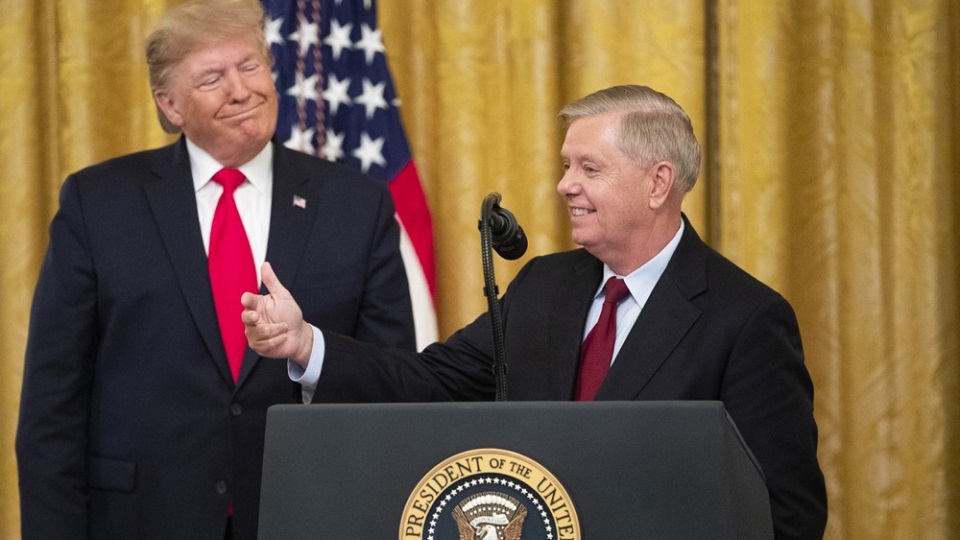
Former President Donald Trump has made a public appeal to the United States Senate, calling for the passage of the Clarity Act, a significant piece of legislation aimed at regulating the cryptocurrency market in America. In an unusual tribute, Trump specifically requested that the bill be approved in honor of Senator Lindsey Graham, the long-serving Republican from South Carolina who has been a prominent ally of the former president throughout his political career. This call to action represents another chapter in Trump’s evolving relationship with the digital asset industry, which has shifted dramatically from skepticism to enthusiastic support.
The Clarity Act represents one of the most comprehensive attempts by Congress to establish a clear regulatory framework for cryptocurrencies and digital assets in the United States. For years, the crypto industry has operated in a regulatory gray zone, with various federal agencies including the Securities and Exchange Commission (SEC) and the Commodity Futures Trading Commission (CFTC) claiming overlapping jurisdictions over different aspects of digital asset markets. This ambiguity has created significant uncertainty for businesses, investors, and innovators in the space, often driving cryptocurrency companies to establish operations in more regulatory-friendly jurisdictions overseas.
The Legislative Push for Crypto Clarity
The proposed legislation aims to definitively classify which digital assets fall under the purview of the SEC as securities and which should be regulated by the CFTC as commodities. This distinction is crucial because securities face much stricter regulatory requirements, including registration processes and ongoing disclosure obligations. Industry advocates have long argued that applying securities laws designed in the 1930s to modern digital assets creates unnecessary barriers to innovation and economic growth. The Clarity Act would establish clear criteria for this classification, potentially unlocking billions of dollars in investment and development within the United States.
Senator Lindsey Graham, whom Trump specifically mentioned in his appeal, has served in the Senate since 2003 and has been a consistent figure in Republican politics for over two decades. While Graham has not been at the forefront of cryptocurrency legislation specifically, his influence within the Republican caucus and his close relationship with Trump make him a symbolically important figure for rallying support. Graham has generally supported pro-business policies and deregulation efforts, positions that align with the cryptocurrency industry’s desire for a more permissive regulatory environment. The invocation of Graham’s name appears designed to encourage Republican senators to unite behind the legislation.
Trump’s Cryptocurrency Evolution
Trump’s current enthusiasm for cryptocurrency marks a remarkable transformation from his earlier positions. During his presidency, Trump was openly critical of Bitcoin and other digital currencies, tweeting in 2019 that he was “not a fan” and that cryptocurrencies were “not money” with values “based on thin air.” However, his stance has shifted considerably in recent years. Trump has launched his own NFT collections, which generated millions in sales, and has increasingly courted the crypto community as a key constituency. This evolution reflects broader changes in how Republicans view digital assets, with many seeing crypto-friendly policies as a way to attract younger voters and technology entrepreneurs to the party.
The timing of Trump’s appeal comes as the cryptocurrency industry faces intensified regulatory scrutiny under the current administration. The SEC under Chair Gary Gensler has pursued aggressive enforcement actions against major crypto exchanges and platforms, arguing that many digital assets are unregistered securities. This crackdown has galvanized industry lobbying efforts and increased pressure on Congress to pass legislation that would limit regulatory agencies’ discretionary authority over the sector. Industry groups have spent tens of millions of dollars on political contributions and advocacy, making crypto regulation one of the most heavily lobbied issues in Washington.
Implications for the Digital Asset Industry
If passed, the Clarity Act could fundamentally reshape the American cryptocurrency landscape. Supporters argue that regulatory clarity would encourage institutional investment, protect consumers through standardized rules, and cement America’s position as a global leader in financial technology. Critics, however, warn that overly permissive regulation could expose retail investors to fraud and market manipulation while potentially facilitating money laundering and other illicit activities. The debate reflects broader tensions between innovation and consumer protection that have characterized financial regulation throughout American history, from the creation of the Federal Reserve to the reforms following the 2008 financial crisis.
The path forward for the Clarity Act remains uncertain, as cryptocurrency legislation must navigate complex political dynamics in both chambers of Congress. While Republicans have generally been more supportive of crypto-friendly policies, some Democrats have also expressed interest in providing regulatory clarity, potentially creating opportunities for bipartisan compromise. The outcome will likely depend on negotiations over specific provisions, including consumer protection measures, stablecoin regulation, and the precise criteria for distinguishing securities from commodities. As digital assets continue to grow in economic significance and public awareness, the pressure on lawmakers to act will only intensify in the coming months.
Expert Opinion: The push for cryptocurrency legislation represents a critical inflection point for the digital asset industry in America. If the Clarity Act or similar legislation passes, we could see a significant repatriation of crypto businesses and capital that had moved offshore due to regulatory uncertainty. However, the ultimate impact will depend heavily on the specific regulatory boundaries established and how enforcement agencies interpret their new mandates in practice.